
Ann Scheliga
Biography of instructor/staff member #1
Email Address: ann_scheliga@berkeley.edu
CIROH_HydroLearn
This course introduces students to flood analysis through an application to the floods caused by Hurricane Helene in Ashville. Students will learn how to collect and use flood hydrograph. Also. to develop and evaluate flood inundation mapping using unsteady flow 2D HEC-RAS simulations while considering uncertainties in Manning's roughness coefficient.
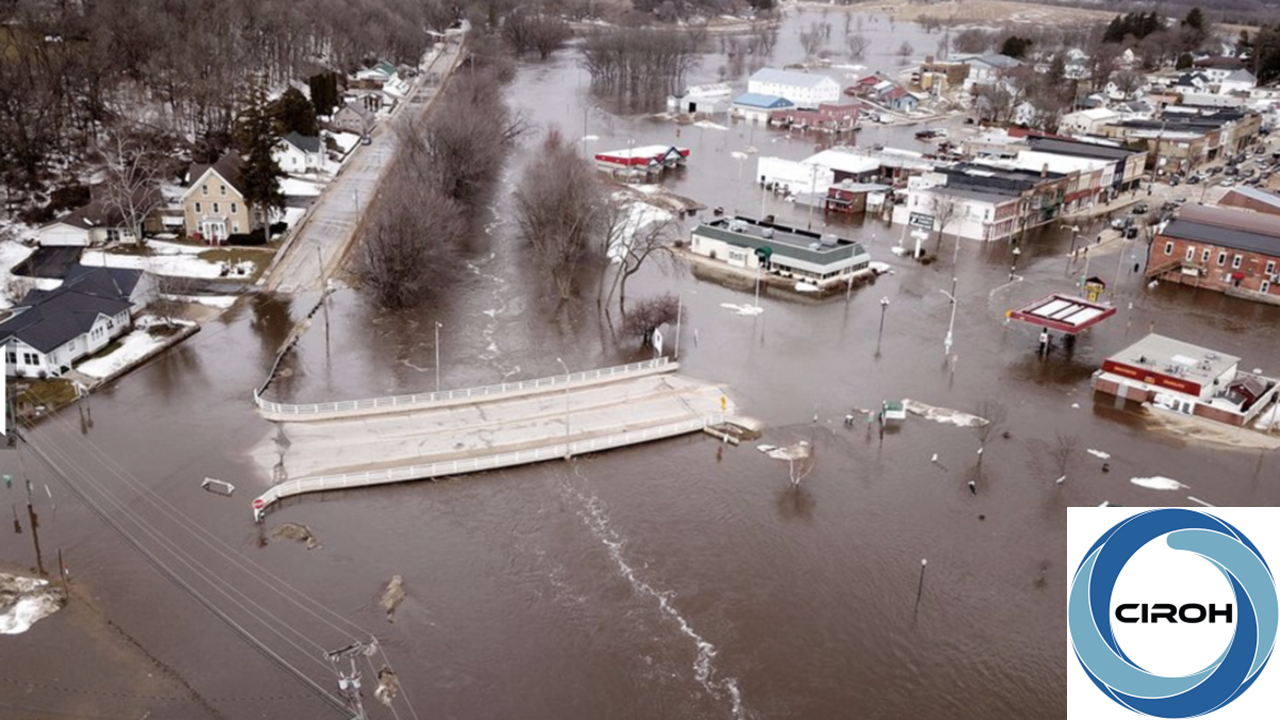
Water resources engineers are frequently required to protect people and property from the impacts of flooding. In order to determine the depth of flood waters and to determine the size or width of floodplains, engineers must first examine the watershed hydrology to determine the amount of water that will reach a stream and be carried by the stream during a flood event, how long it resides in the watershed, and what pathway it takes to the stream channel. Then, the principles of hydraulics are applied to understand how the water flows through the stream channel and across the floodplain.
This module addresses questions related to flood mapping and examines how flood maps are generated from streamflow inputs. You will learn the theoretical underpinnings used to analyze gradually varied flow conditions and eventually use the HEC-RAS model to simulate flood extents for different Manning’s roughness values using unsteady flow analysis. The sections of the module are organized as outlined below.
Section 1 - Summary and overview
Section 2 - Data Collection: Retrieving streamflow observations.
Section 3 - Open Channel Flow: Review of open channel hydraulics, application of standard step method.
Section 4 – HEC-RAS: Two-dimensional simulations in HEC-RAS with an application of HEC-RAS to French Broad River.
The contents in this module does not require prerequisites
At the end of this module, students will be able to: (1) retrieve streamflow data, (2) understand the fundamentals of open-channel flow and sources of uncertainty in a hydrodynamic model, and (3) develop and examine a hydrodynamic model for an actual flood event during Hurricane Helene.
"This will be accomplished through activities within each section. Results from each activity will be recorded in specified results templates. The results templates for each activity can be found at the beginning of each activity. The results templates are organized such that results from one activity can easily be used in successive activities."
The intent of this module is to bring together concepts and techniques typically covered in water resources engineering courses using a real-world floodplain analysis and design case study. This module has been designed to be used as a standalone learning activity. The design of the module is such that learners should be able to complete all activities on their own.
Biography of instructor/staff member #1
Email Address: ann_scheliga@berkeley.edu
Biography of instructor/staff member #2
Email Address : sb106@email.sc.eduOperational hydrologists and professionals.
Learners will need a computer with access to Internet and HEC-RAS software [free - runs on Windows or Linux environments]
The module developers estimate that this module will take about an hour to complete.
This course is available for export by clicking the "Export Link" at the top right of this page. You will need a HydroLearn instructor studio account to do this. You will first need to sign up for a hydrolearn.org account, then you should register as an instructor by clicking 'studio.hydrolearn' and requesting course creation permissions.
Balachandran, S. and Scheliga, A. (2025). Introduction to Floodplain Analysis. CIROH_HydroLearn. https://edx.hydrolearn.org/courses/course-v1:CIROH_HydroLearn+OP_050+2025/about
This course is adapted from: Polebitski, A. and Smith, T. (2020). Introduction to Floodplain Analysis. HydroLearn. https://edx.hydrolearn.org/courses/course-v1:UW_Platteville+CEE4300+F2020/about.
Go into detail about how this module differs from the original. If your module is an original creation, you can delete this section.
This project received funding under award NA22NWS4320003 by National Oceanic and Atmospheric Administration (NOAA) Cooperative Institute Program to the Cooperative Institute for Research on Hydrology (CIROH) through the University of Alabama. The statements, findings, conclusions, and recommendations are those of the author(s) and do not necessarily reflect the opinions of NOAA.