Problem Statement
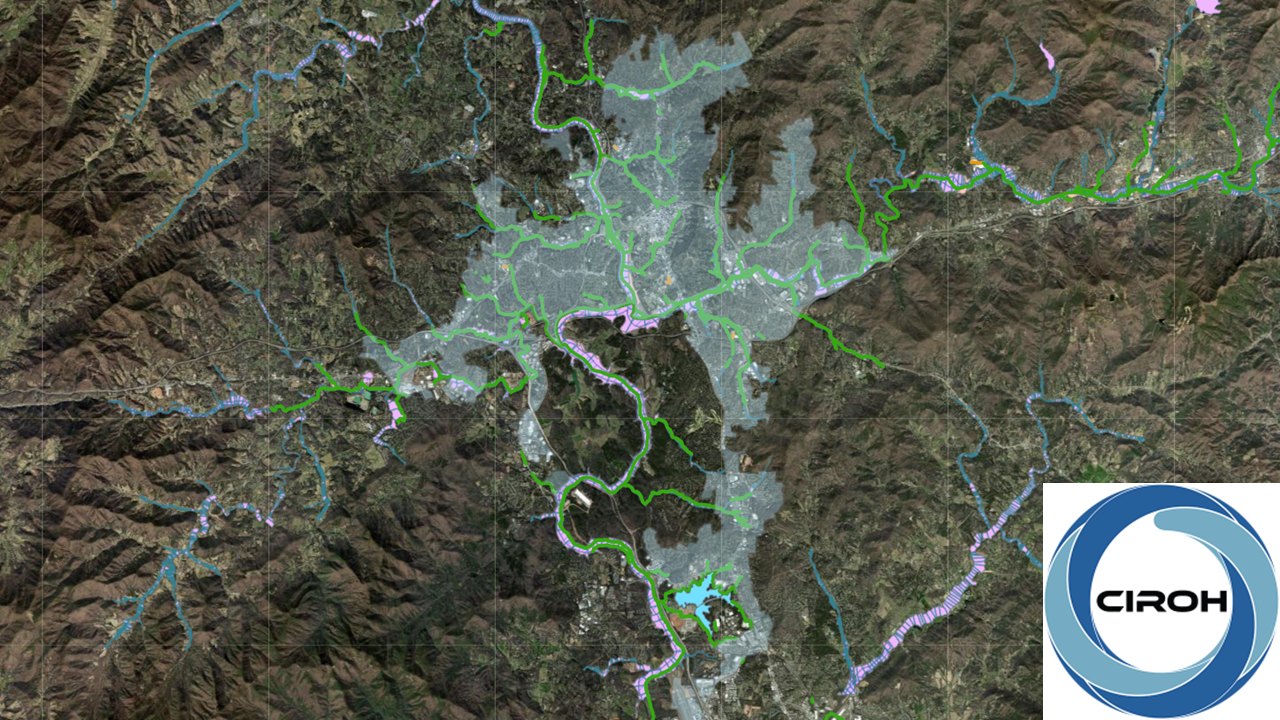
Imagine this: You’re part of a dynamic team at a water resources management company, and your boss has just walked in with a pressing concern. A hurricane—Hurricane Helene (2024)—is approaching, and the Asheville Watershed is at risk. Your boss wants a detailed report on potential flood-prone areas and how the watershed might respond to the heavy rainfall and strong winds. “We need to be prepared,” they say. “Our community relies on us to protect their water resources and mitigate flood damage.”
The Asheville Watershed spans 18,000 acres and serves as a lifeline, providing drinking water to over 125,000 people. However, its mountainous terrain and history of extreme weather events make it particularly vulnerable to flooding. The problem? There’s no comprehensive analysis of its drainage patterns, sub-watersheds, or areas most likely to flood. Without this critical information, implementing effective flood mitigation strategies is nearly impossible.
Your task is clear: Delineate the watershed, analyze its hydrological characteristics—such as flow networks, slopes, soil types, and land use—and identify flood-prone zones. This information will not only prepare your team for the immediate threat of Hurricane Helene but also lay the groundwork for sustainable watershed management strategies. With accurate data and analysis, your company can help protect Asheville’s community, infrastructure, and vital water resources from future climatic events.
Module Overview
In this module, learners will focus on delineating key watershed boundaries using the NextGen hydrofabric, exploring how terrain, land use, and hydrologic connections shape flood risk in places like Asheville. They will learn to interpret geospatial data, understand the role of catchments and flowpaths, and apply standardized workflows in real-world scenarios. By the end, participants will be equipped to examine the physical factors behind Hurricane Helene’s devastating impacts, setting the stage for improved flood preparedness and a deeper understanding of watershed behavior.
Topics Covered
- Watershed Characteristics: Understanding key features such as drainage patterns, land use, soil types, and hydrological attributes.
- Watershed Delineation: Techniques and tools for identifying watershed boundaries and analyzing upstream and downstream connectivity.
Prerequisites
Hydrology: Familiarity with the concepts of hydrological modeling and basic understanding of watershed processes.
GIS: Ability to use GIS tools to extract and analyze spatial information, such as delineating watersheds and mapping hydrological features.
Python: Basic knowledge of Python, including running scripts and using libraries for data processing and analysis.
Command Line: Understanding of command line operations to execute scripts, manage files, and perform basic troubleshooting.
Learners need to be comfortable working with command line tools in a linux environment. The module uses NextGen in a Box preprocessor software that learners will need to download and install to complete the active learning parts of the module.
Learning Objectives
Develop a foundational understanding of the Asheville watershed as a study site, including its physical setting, drainage characteristics, and flood-prone features, with emphasis on areas impacted by Hurricane Helene.
Using the CIROH Python-based NGIAB data preprocess tool, professional audience will delineate the Asheville watershed and its sub-catchments.
By combining insights from the NGIAB tool and their understanding of the Asheville watershed setting, learners will evaluate how watershed characteristics influenced the flooding during Hurricane Helene and how this knowledge can inform future flood mitigation strategies.
Suggested Implementation
This module is designed for operational hydrologists and practitioners who require practical, hands-on tools for watershed delineation and hydrological analysis in real-world applications. It can be integrated into existing operational workflows, technical training programs, or onboarding processes for hydrologic analysis teams. The following approaches can enhance its effectiveness:
- Hands-On Application: Encourage users to apply the module to their specific regions or basins using real datasets, aerial imagery, and tools such as the NGIAB data preprocess tool to support operational decision-making.
- Workflow Guidance: Provide clear, actionable instructions that align with operational tasks, enabling efficient and consistent application of the methods. Short tutorial videos or quick-reference guides can support rapid adoption.
- Collaborative Analysis: Support collaboration among team members or across departments to compare results, share insights, and improve consistency in watershed analysis.
- Operational Relevance: Emphasize how the module supports real-world applications such as flood forecasting, water resource management, and environmental assessment, ensuring outputs are directly usable in practice.
- Performance and Quality Control: Use output templates and results to support quality assurance, reproducibility, and continuous improvement of hydrological analyses.
By following these approaches, operational hydrologists can efficiently apply watershed delineation and analysis techniques to support informed decision-making and real-world hydrologic applications.
Course Authors
Mohammad Farmani
Mohammad Farmani is a third-year Ph.D. candidate in Hydrology and Atmospheric Sciences with a minor in Data Science at the University of Arizona. His research focuses on improving hydrological modeling by integrating physical-based approaches with advanced machine learning techniques. Mohammad has extensive experience working with the Noah-MP land surface model and has applied it to study soil-water processes, runoff generation, and baseflow dynamics, particularly in arid regions.
His work focuses on integrating physical-based approaches with advanced machine learning techniques to improve hydrological modeling and decision-making. He has significant experience with the Noah-MP land surface model and hydrological tools like SWMM, HEC-HMS, and RAPID. In addition to his research, Mohammad is actively involved in educational initiatives, aiming to bridge the gap between theory and application in hydrology and environmental sciences.
farmani@arizona.edu
Md. Shahabul Alam
Md. Shahabul Alam (PhD, 2020, University of Saskatchewan) is a Research Scientist at Alabama Water Institute, The University of Alabama. He is a Civil Engineer focused on large-scale hydrological modeling, model calibration and evaluation for the extreme events, climate change adaptation, and transboundary water resource management. His primary goal is to advance the Next Generation Water Resources Modeling Framework (NextGen) by conducting cutting-edge research within the Cooperative Institute for Research to Operations in Hydrology (CIROH).
malam24@ua.edu
Target Audience
The module is ideal for operations professionals seeking practical experience in delineating watersheds and analyzing hydrological characteristics.
Expected Effort
The module developers estimate that this module will take between 3 to 5 hours of active work time to complete. This includes time spent on reviewing background materials, conducting analyses using provided tools, and completing all activities and assignments.
The estimated effort accounts for engaging with interactive maps, processing data using Python-based tools, and compiling results in the provided templates. professional audiences are encouraged to allocate additional time for discussions and refining their final reports if needed.
Course Sharing and Adaptation
This course is available for export by clicking the "Export Link" at the top right of this page. You will need a HydroLearn instructor studio account to do this. You will first need to sign up for a hydrolearn.org account, then you should register as an instructor by clicking 'studio.hydrolearn' and requesting course creation permissions.
Data Disclaimer
This experimental data represents the NWS’s best approximation of the maximum inundation extent that occurred on Sep. 26 (or Sep. 27), 2024, as of Jan 6, 2025, based upon modeled river discharge. These maps were not publicly available during the event (coinciding with Hurricane Helene). This information should be used for educational purposes only.
Acknowledgement
This project received funding under award NA22NWS4320003 by National Oceanic and Atmospheric Administration (NOAA) Cooperative Institute Program to the Cooperative Institute for Research on Hydrology (CIROH) through the University of Alabama. The statements, findings, conclusions, and recommendations are those of the author(s) and do not necessarily reflect the opinions of NOAA.