

University_of_Nebraska-Lincoln
Food-Energy-Water-Nexus
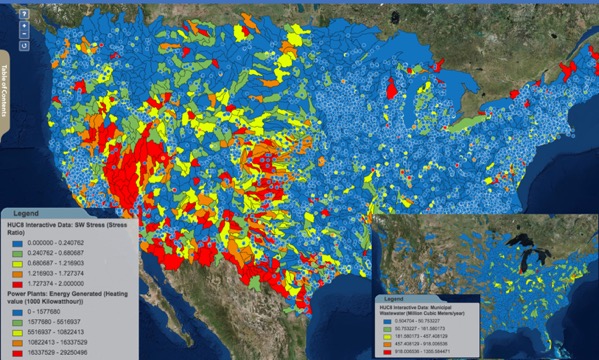
Water resource systems are faced with meeting the challenge of growing demands coupled with the potential for added stress from climate change in the coming decades. This module introduces students to the concept of water stress through set of data- and hypothesis-driven learning activities that assess water supply, demands and stresses over the entire domain of the Contiguous US. The analysis is conducted at the scale of eight-digit watershed hydrologic unit code (HUC8). The learning activities guides students to examine water supply, both from surface and groundwater sources, and water use by different sectors (irrigation, municipal and industrial, and thermoelectric). Students calculate water stress indices at different U.S. basins and identify regions with water availability or shortages. Acknowledging the alarming rates of groundwater depletion in many US regions, students re-formulate the water stress indices focusing on groundwater, identify how much the thermoelectric sector is responsible for groundwater use, and explore opportunities for reducing groundwater use by tapping into non-traditional resources (e.g., treated domestic wastewater).
Enrollment is Closed
Module Overview
Water resource systems are faced with meeting the challenge of growing demands coupled with the potential for added stress from climate change in the coming decades. This module introduces students to the concept of water stress through set of data- and hypothesis-driven learning activities that assess water supply, demands and stresses over the entire domain of the Contiguous US. The analysis is conducted at the scale of eight-digit watershed hydrologic unit code (HUC8). The learning activities guides students to examine water supply, both from surface and groundwater sources, and water use by different sectors (irrigation, municipal and industrial, and thermoelectric). Students calculate water stress indices at different U.S. basins and identify regions with water availability or shortages. Acknowledging the alarming rates of groundwater depletion in many US regions, students re-formulate the water stress indices focusing on groundwater, identify how much the thermoelectric sector is responsible for groundwater use, and explore opportunities for reducing groundwater use by tapping into non-traditional resources (e.g., treated domestic wastewater).
Topics covered
(1) Analysis of water supply and demand (2) Analysis of stress on surface and groundwater systems (3) Sectoral analysis of water stresses (4) Impact of environmental flows (5) Analysis of groundwater depletion
Prerequisites
N/A
Course Authors

Hisham Eldardiry
PhD Candidate, University of Washington Seattle. Contact: hishameldardiry@gmail.com
Hanz Unruh
PhD Candidate, University of Louisiana at Lafayette. Contact:C00062543@louisiana.edu
Vincent Tidwell
Sandia National Laboratories. Contact: vctidwe@sandia.govTarget Audience
Junior/Senior Hydrology and Water Resources Engineering Courses
Tools Needed
Computer with access to Internet, Excel, and free QGIS software