Emad Habib, PhD, PE
University of Louisiana at Lafayette. Contact: emad.habib@louisiana.edu

HydroLearn
Wetlands in Louisiana’s Chenier Plain are undergoing persistent deterioration that will become increasingly problematic if not adequately addressed. While the cause of the problem is sometimes apparent the solution is not always as straightforward. Many restoration plans are proposed and their acceptance depends on many factors the first and foremost of which is the feasibility of the proposed project. This module examines a proposed restoration project aimed at reducing salinity levels in a coastal marsh area by increasing the introduction of freshwater to the area. To assess the feasibility of the project a lumped box model is constructed in which meteorological fluxes and flow exchanges through local control are considered and quantified.
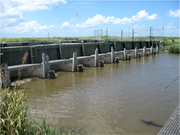
Wetlands in Louisiana’s Chenier Plain are undergoing persistent deterioration that will become increasingly problematic if not adequately addressed. Many types of projects are proposed with the ultimate goal of protecting and/or restoring the wetlands. One such type of project is freshwater introduction aimed at decreasing the salinity levels within a marsh ecosystem. Sustained saltwater intrusion is one of the leading causes of marsh fragility and land loss in coastal Louisiana. In order to determine the potential impact and effectiveness of any given project, computer models are used to simulate the hydrology of the area both with and without the project. Understanding the theory behind the model as well as methods used to construct and evaluate the model is vital to implementing successful restoration activities.
This module is based on a case study of a fresh water introduction restoration project located near Pecan Island in Coastal Louisiana. It is one of two modules developed for this particular case study and concentrates on developing a mass balance model to determine the feasibility of the freshwater introduction project. The second module, “Pecan Island Freshwater Introduction Restoration Project: Channel Design” concentrates on using a one-dimensional unsteady flow simulator to assist in the hydraulic design of the proposed conveyance channel. The two modules were developed to act independently of one another and may be attempted with no regard to sequence.
In this module, you will develop the skills necessary to construct and calibrate a mass balance model and address the feasibility of a coastal restoration project. The module is organized into 8 sections. Overview of the Restoration Project (Section 1) Mass Balance Model (Section 2) Data Preparation (Section 3) Modeling Flow through Structures (Section 4) Model Setup (Section 5) Model Calibration and Evaluation (Section 6) Simulation of Project Impact (Section 7) Topics for Further Consideration (Section 8) In Section 1, you will be introduced to the ME-23 freshwater introduction project and gain an understanding of how coastal marshes are maintained using control structures and marsh management plans. Section 2 will introduce the concept of a mass balance model and present the fundamental equations used to calculate water volume, water level, and salinity in this module. Section 3 will involve collecting and preparing times series data that will be used in the model. After the necessary time series data is retrieved, Section 4 will discuss details of the 4 existing control structures and how orifice and weir equations will be applied to describe the flow through these 4 unique structures. In Section 5 the mass balance model will be constructed in Excel using the mass balance equations, weir and orifice equations, and the times series data. Once the model is constructed, Section 6 will involve calibrating and evaluating the model using observed values and statistics. Section 7 will address the impact and feasibility of the project. Lastly, Section 8 will conclude the module by addressing the challenges and uncertainties involved with numerical.d
N/A
This module is designed to give insight on the purpose and goals of the ME-23 project, help understand the techniques of wetland conservation used in ME-23, and give a quick summary of the four structures that influence water levels and salinity within the project area. The objectives of this module are to apply hydrologic equations to develop a lumped box model to simulate the operation of a hydrologic structure and to assess the performance of a more complex model.
University of Louisiana at Lafayette. Contact: emad.habib@louisiana.edu
University of Louisiana at Lafayette. Contact: Robert.Miller@louisiana.edu
University of Louisiana at Lafayette Master's student graduate
Water Resources Engineer at Dewberry. Contact: MDeshotel@dewberry.com
University of Louisiana at Lafayette. Contact: C00097172@louisiana.edu
Junior/Senior Hydrology Courses
Computer with access to Internet, Excel
This course is available for export by clicking the "Export Link" at the top right of this page. If you are an Instructor seeking the answer keys, please contact the course creators using your official University email account.
20-30 hours