
Emma Hibbert
Biography of instructor/staff member #1
e.hibbert@northeastern.edu
CIROH
Learn the basics of how to do end-user engagement in the development of hydrological tools and why it is important.
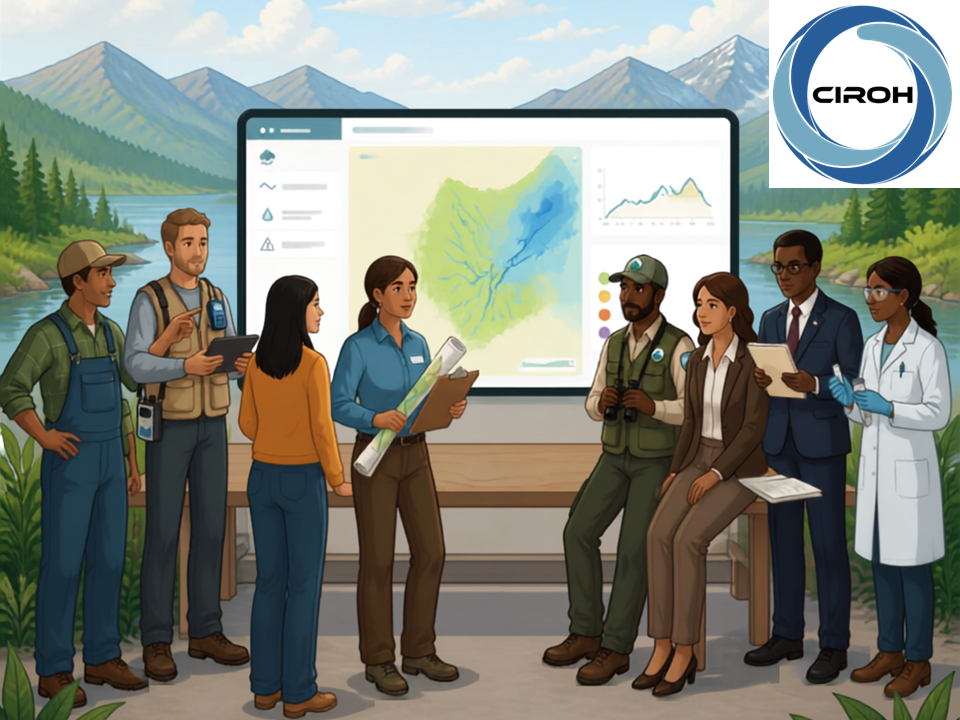
Valuable water data exists, but it often does not reach all end users who stand to benefit from its use, due to a lack of awareness, relevance, or usability of hydrological tools. These end users can include local decision-makers, business owners, farmers, conservation practitioners, and regional planners. Systematically engaging end users in the development of hydrological tools is one way to ensure critical water data is accessed and used by local decision-makers. In this module, we detail the benefits of end-user engagement and a spectrum of collaborative approaches that can be integrated into project plans to identify, engage, and partner with diverse end users.
This learning module introduces the basics of end-user engagement and highlights why it is essential for the water science community when developing and deploying hydrological tools. At the end of this module, learners will be able to design an end-user engagement plan that identifies and engages diverse end users while applying best ethical and methodological practices.
To achieve the stated goals, this module answers the following:
No prerequisite knowledge required. We only request a willingness to learn how proposed or existing hydrological tools can expand their impact by reaching new end users and/or be applied to new use cases through end-user engagement.
At the end of this module, students will be able to:
These will be assessed through activities within each section as well as a final authentic task.
Biography of instructor/staff member #1
e.hibbert@northeastern.edu
Biography of instructor/staff member #2
d.rinconreyes@northeastern.eduThere are sample solutions provided with each activity in the course.
This module is designed to be completed by anyone, particularly those responsible for designing hydrological tools or services, who have an interest in understanding how their work may be applied to new audiences, and/or would like to effectively engage end users in their work.
There are no specific tools or software needed.
The module developers estimate that this module will take between 2.5 to 4 hours to complete.
This course is available for export by clicking the "Export Link" at the top right of this page. You will need a HydroLearn instructor studio account to do this. You will first need to sign up for a hydrolearn.org account, then you should register as an instructor by clicking 'studio.hydrolearn' and requesting course creation permissions.
Rincon Reyes, D. & Hibbert, E. (2026). Engaging diverse end users in the development of hydrological tools. CIROH. https://edx.hydrolearn.org/courses/course-v1:CIROH_HydroLearn+HLNEU+2026/about
The authors would like to acknowledge Dr. Kristin Raub for her contributions to the development of this module, particularly as a technical mentor, and her expertise in community engagement theory and practice. Funding for this project was provided by the National Oceanic and Atmospheric Administration (NOAA), awarded to the Cooperative Institute for Research to Operations in Hydrology (CIROH) through the NOAA Cooperative Agreement with The University of Alabama, NA22NWS4320003.